Evaluating Appendix Tumors

Pediatric surgeon Brian Gilchrist, MD, has held medical appointments at Saint Vincent’s Hospital and the Floating Hospital for Children at Tufts University. Brian Gilchrist, MD, focuses on minimally-invasive procedures addressing congenital conditions and has written extensively on internal diseases, including appendiceal tumors.

While appendiceal cancers are rare, tumors found in the appendix are often evaluated through an examination and biopsy. Since malignant appendix tumors can appear as ovarian or gastrointestinal cancers, they can be difficult to diagnose. The most prevalent tumors are carcinoid and measure fewer than two centimeters in size. Patients with this condition may not experience symptoms until the disorder has impacted the liver. Most appendiceal tumors are uncovered during screenings for other conditions.

Non-carcinoid tumors are more aggressive and can cause a buildup in biological substances that can lead to digestive problems. Tumors that have the ability to spread to the lymph nodes and other organs as well as very large masses are usually removed. Small, benign tumors may be monitored.

Iatrogenic Vascular Lesions – Wounds Related to Medical Treatment

Based in New York City, Brian Gilchrist, MD, has an extensive leadership background in pediatric medicine and has published widely on pediatric and neonatal surgical topics. One area in which Brian Gilchrist, MD, has worked extensively is iatrogenic vascular lesions, a type of wound involving organ or tissue damage resulting from necessary medical treatment.

As the number of minimally invasive therapeutic and diagnostic procedures increases, iatrogenic complications have occurred more frequently. When it comes to vascular procedures, the common femoral artery represents the most common arterial access point, with complication rates in the 6 percent range. Iatrogenic vascular lesions also may occur include at access points in the wrist, elbow, and knee.

There are multiple ways to manage injuries related to iatrogenic lesions at femoral artery access points. One such procedure involves catheter embolization, with clotting agents or devices transmitted into the blood vessel. This limits blood flow to the region, addresses issues of abnormal bleeding, and gives the body an opportunity to heal.

What You Need to Know about Pilonidal Disease

An experienced pediatric surgeon, Dr. Brian Gilchrist completed pediatric surgery residency training at numerous institutions and hospitals, including the University of Tennessee. Dr. Brian Gilchrist works to provide less painful, minimally-invasive surgical interventions for treating various diseases, including pilonidal disease. Since 2009, he has performed over 250 minimally-invasive procedures for pilonidal disease with no instance of complication or disease recurrence.

Pilonidal disease is a chronic skin infection that affects the crease of the buttocks – anywhere around the area on top of the tailbone to the anus. Often, the disease occurs between the onset of puberty and age 40. It is three to four times more prevalent among males than females.

Symptoms may include a small dimple or large painful mass in the affected area; pain that worsens when a patient sits; and fluid (clear, cloudy, or containing blood) draining from the site. If the area is infected, it may become red and tender, drainage fluid may have a funky order, and patients may also exhibit common symptoms of infectious disease (such as nausea and fever).

In almost all cases, the condition starts with an acute abscess episode when the area becomes tender and swollen. Pus may also drain from it. The abscess may go away naturally over time or with medical care. Once the abscess is gone, the patient may develop a pilonidal sinus. A pilonidal sinus is a cavity or empty space below the skin in the affected area that connects to the skin surface through one or more openings. In the majority of the cases, this needs to be corrected with surgery.

What Is Pilonidal Disease?

Experienced pediatric surgeon Brian Gilchrist, MD, completed a fellowship in pediatric and transplantation surgery at St. Jude Children’s Research Hospital and Harvard Medical School, respectively. With upwards of 30 years of medical experience, Dr. Brian Gilchrist is familiar with a range of congenital diseases, including pilonidal disease.

Pilonidal disease refers to a chronic skin infection that occurs at the crease of the buttocks near the tailbone, or coccyx. It results in at least one cyst that becomes infected or inflamed, creating the appearance of a small dimple in the area. Sometimes hair grows out of this dimple, but this isn’t always the case.

As the infection worsens, it creates a large, painful mass just above the buttocks and can result in the area becoming red and tender and leaking bloody or cloudy fluid. Patients may also present with a fever or feelings of nausea as their body responds to the infection.

To treat the cyst that forms, physicians will either remove it surgically or open and drain it. If a patient experiences a returning infected pilonidal cyst, surgery is the standard treatment option. Once the cyst is removed or drained, a pilonidal sinus will typically form in the area. This cavity below the surface of the skin will either resolve on its own or necessitate surgical removal.

Following treatment of the cyst, patients must keep the surgical site clean and dry as the skin heals. They must also remove hair from the buttocks crease via a hair removal agent or razor. Doing so reduces the risk of developing another cyst.

Risk Factors and Common Age of Infants with NEC

The former chief of pediatric surgery at a New York hospital, Brian Gilchrist, MD, has been practicing medicine for more than three decades. During that time, Dr. Brian Gilchrist has become familiar with a wide range of congenital and pediatric conditions, including necrotizing enterocolitis (NEC).

A serious illness, NEC affects the intestines of infants. Babies with this condition have inflammation in their large intestine, or colon, that damages and kills intestinal tissue. When left untreated, this damage leaves the abdomen open to germs that may lead to death or a serious infection.

A rare condition, NEC affects 1 out of every 2,000 to 4,000 infants. While physicians are unsure of what causes NEC, it occurs most often in premature babies who weigh less than 3.25 pounds. These infants have less mature lungs and intestines that cannot properly move oxygen and blood around. As a result, they struggle with fighting infection and breaking down food — characteristics that physicians believe make them more susceptible to NEC.

In addition to occurring more frequently in premature infants, NEC affects babies who regularly experience other illnesses. These babies may have too many red blood cells, an existing gastrointestinal infection, or received a blood transfusion. Premature babies fed formula are also at greater risk, as are those with reduced oxygen levels.

Common Treatments for Necrotizing Enterocolitis

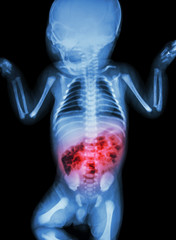
Enteritis (X-ray of sick infant and inflammation of intestine)

Dr. Brian Gilchrist, a skilled pediatric surgeon with over 30 years of experience, has held many teaching roles and has been invited to give numerous presentations and lectures before medical professionals. Dedicated to advancing knowledge in the medical field, Dr. Brian Gilchrist edited a book about necrotizing enterocolitis (NEC).

A gastrointestinal disease that affects both premature and full-term infants, NEC is responsible for inflammation and infection in the intestines, leading to the damage and death of intestinal cells. The condition is categorized into three stages:

– Stage one is suspected NEC with mild symptoms such as lethargy and bloody stool;

– Stage two is definite NEC with the symptoms of stage one along with pain when the abdomen is touched and low blood platelet levels;

– Stage three is advanced NEC accompanied by low blood pressure and other issues.

Treatment of NEC depends on the stage, age, overall health, and tolerance to the medication. Surgery is usually required for stage three NEC. By this point, a hole may have developed in the bowel or intestine. Surgery removes the affected area and leaves undamaged intestines to regain their normal function.

Necrotizing Enterocolitis – Severe Intestinal Disease in Newborns

A member of the American Pediatric Surgical Association, Dr. Brian Gilchrist is a New York-based pediatric surgeon who has delivered lectures worldwide and has written and edited numerous publications on neonatal and pediatric surgical topics. Dr. Brian Gilchrist’s works include a book on necrotizing enterocolitis that is well-referenced in neonatal intensive care units across the country. Necrotizing enterocolitis (NEC) is a life-threatening intestinal disease with a high mortality rate in newborns and is the most frequent gastrointestinal emergency in NICUs.

The condition, which is characterized by inflammation and the bacterial invasion of the large intestine, most commonly affects severely ill and premature infants, particularly ones who weigh less than 3 pounds, 4 ounces. Intestinal tissue damage and death can occur as result of the inflammation and bacteria, which can create a hole in the intestines and destroy its walls. Symptoms usually appear within two weeks after a baby’s birth and can include bloody bowel movements, stomach bloating, fever, green bile, and poor feeding tolerance. Lethargy, slow heart rate, and pauses in breathing can also indicate infection.

Despite continuous research, the specific cause of NEC remains unknown. Medical professionals believe that low blood and oxygen flow play a part because the disease is most prevalent in premature infants who are born with weaker and immature lungs and intestines. These babies also have trouble fighting infection and breaking down food. In addition to premature birth, factors such as intestinal infections, difficult birth, and formula feeding for high-risk and premature infants can heighten the risk of NEC.

Healthcare providers can diagnose NEC by examining babies for signs of the condition and conducting an abdominal X-ray. A bubbly appearance in the intestine and indicators of gas or air in a child’s large veins in the liver are NEC indicators that can show up in an X-ray. Treatment can vary due to multiple factors, such as the severity of the disease and the child’s symptoms, general health, and age. Common steps can include halting feedings, providing intravenous fluids and nutrition, and offering oxygen support and using breathing machines.

Design a site like this with WordPress.com
Get started